The skeleton of the legendary musketeer, the central hero of Dumas’ famous novel, may have been discovered at his reputed death site
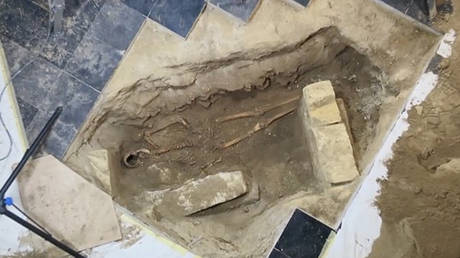
Archaeologists say they may have discovered the skeletal remains of the legendary D’Artagnan, the figure immortalized by French writer Alexandre Dumas in ‘The Three Musketeers’, Dutch regional broadcaster L1 reported on Wednesday.
The remains were found in the Dutch city of Maastricht. Historical accounts say Charles de Batz de Castelmore, on whom the novel’s fourth musketeer is based, was killed there by a shot from a musket during King Louis XIV’s siege of the city in June 1673.
Historians believe Louis XIV had D’Artagnan, who served as captain of his elite Musketeers of the Guard, buried in what was then the village of Wolder, now part of Maastricht. No confirmed remains have been found to date.
The grave was discovered under a church in what is now a rural neighborhood of the city, L1 reported. Renovators came upon the find during maintenance work, after the building’s floor suffered a collapse last month, it said. The modern chapel is thought to be the second or third structure built on the historical site going back to as early as the 11th century.
“The location of the tomb indicates that it is an important person: the skeleton was on the spot where the altar used to stand and only royal or other important figures were buried under the altar at the time,” L1 cited Deacon Jos Valke, who was present at the initial excavation, as saying.
A French coin and a musket bullet were found with the remains, the broadcaster reported. DNA taken from the teeth has been sent to a lab in Munich for comparison with that of a descendant of the de Batz family, it added.
D’Artagnan became a national hero in France and gained worldwide fame after the publication of Dumas’ 1844 novel. The work has inspired many screen adaptations.
The 1979 Soviet mini-series D’Artagnan and Three Musketeers remains one of the most popular adaptations in Russia, known for its music and humor.











 Like
0
Like
0
 Dislike
0
Dislike
0
 Love
0
Love
0
 Funny
0
Funny
0
 Angry
0
Angry
0
 Sad
0
Sad
0
 Wow
0
Wow
0