The military alliance between three Sunni Muslim countries offers a powerful symbolism in a region wracked by conflict
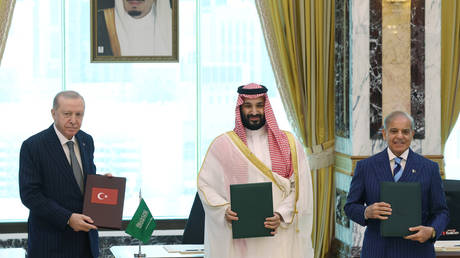
Saudi Arabia, Pakistan, and Türkiye signed a defense pact on Friday, sparking talk of a NATO style grouping that could alter the regional power balance.
The bloc’s formation comes amid a volatile security situation in the Middle East, triggered by the US-Israeli attacks on Iran. Tehran’s retaliation against Gulf monarchies, who have been traditional US allies, has exposed the limitations of the American security umbrella and forced the Gulf Arabs to think of alternative security frameworks.
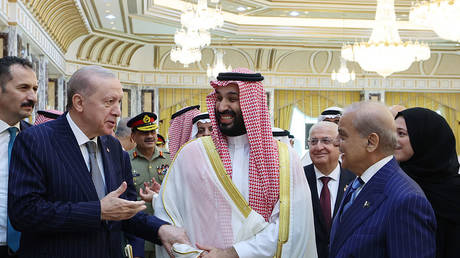
The pact was signed in Mecca by Saudi Crown Prince Mohammed bin Salman, Turkish President Tayyip Erdogan and Pakistani Prime Minister Shehbaz Sharif.
Pakistan’s Foreign Ministry said in a statement that an armed attack on any one of the three countries would be regarded as an attack against them all. However, whether such an attack would elicit a combined military response – on the lines of NATO’s Article 5 collective defense commitments – from the bloc is not clear.
Why is the pact significant?
Still, the military alliance between three Sunni Muslim countries offers a powerful symbolism in a region wracked by conflict.
The chairman of the Saudi-based think tank Gulf Research Center, Abdulaziz Sager, told Reuters, “the trilateral framework could strengthen the three countries’ collective diplomatic and defense weight while contributing to the emergence of a more regionally driven security architecture.”
The three players bring very powerful assets to the grouping: Pakistan is the only Muslim country with a nuclear arsenal; Türkiye has a robust defense industry and the second-largest military in NATO; and Saudi Arabia – the world’s biggest crude exporter – has the financial muscle, apart from a military bristling with American weapons.
However, experts note that this is not the first attempt to establish a similar counterweight in the region, and the latest pact may not immediately be a “gamechanger.”
“I wouldn’t go to the extent of calling it Islamic NATO or the emergence of a new security block or a new alliance or… alignment,” Middle East expert and an associate professor at New Delhi’s Jawaharlal Nehru University, Muhammad Mudassir Qamar, told RT India. He noted that such attempts at alliance have been made in the past.
What led to the Mecca agreement?
The Mecca agreement followed months of negotiations and builds on a similar agreement between Riyadh and Islamabad last year, and also a growing military relationship between Islamabad and Ankara.
The Saudi-Pakistan defense pact had offered Riyadh a nuclear-backed deterrent as Iran, Israel, and the US reshaped the security calculus of the Gulf countries. Several thousand Pakistani troops, 16 fighter jets, drones and even a Chinese-made air defense system are already based in eastern Saudi Arabia.
Pakistan’s military already fields Turkish drones and other weapons systems, some of which were used in its clash with India last year. The Mideast conflict has also upset the security equilibrium in the region, with Iran and its proxy militias striking with relative impunity despite sustained US attacks, alarming the Gulf Arab countries.
Ankara is nervous about the US support for Kurdish militias against Iran, one of the components of the initial US-Israeli plan to topple the Iranian government.
Islamabad has ambitions to be a major regional player in Central Asia and the Middle East, leveraging its friendly ties with Muslim countries in the region.
How other countries have responded
Iran, which has long tried to dominate the Gulf’s security scene and shares a border with Pakistan, has called it a “paper agreement.”
“Saudis must know that a paper agreement with Turkey and Pakistan will not bring them security, just as years of one-sided nursing to the Americans did not bring them security,” Ebrahim Rezaei, a member of Iran’s Parliament and National Security and Foreign Policy Commission posted on X.
India, which has a tense relationship with Pakistan and is angry at Ankara’s support for Islamabad, said it was watching the developments closely. “This is also a development that we are closely following, and we shall keep you updated,” Indian Foreign Ministry spokesman Randhir Jaiswal told reporters.
This emerging defense alignment does not affect India’s defense calculus or alignments in the region, but still merits attention, according to Jawaharlal Nehru University’s Qamar.
Still, he suggested, it means a more complex regional security calculus in the years ahead for India, although New Delhi’s deepening ties with Riyadh will be an important counterweight.









 Like
0
Like
0
 Dislike
0
Dislike
0
 Love
0
Love
0
 Funny
0
Funny
0
 Angry
0
Angry
0
 Sad
0
Sad
0
 Wow
0
Wow
0