Migrant crime is ripping open old divisions in Northern Ireland
The American and British right want you to believe that the Belfast riots are a violent Irish uprising against mass immigration. In reality, the riots are steeped in the complex sectarianism of Northern Ireland, and the riot leaders don’t even consider themselves Irish.
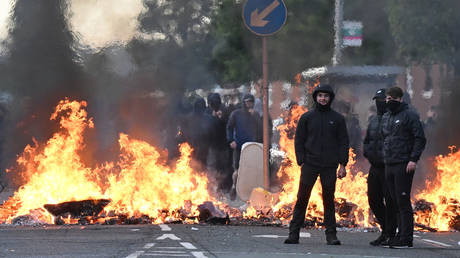
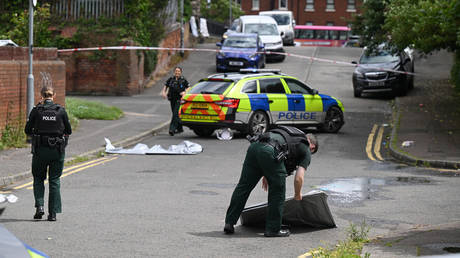
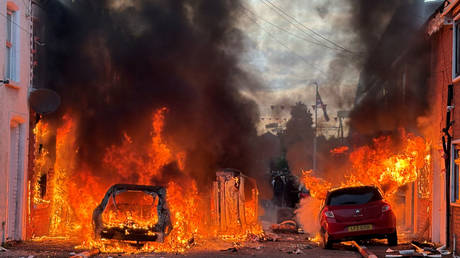
The attempted beheading of an Irish man by a Sudanese migrant set off a wave of unrest in Belfast this week. Less than 24 hours after the attack, gangs of masked men torched more than 60 buildings and vehicles, sweeping door-to-door through the city’s northern neighborhoods in a deliberate attempt to “get the foreigners out,” according to the BBC.
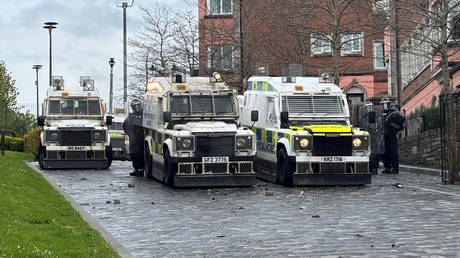
The violence continued on Wednesday, with more loosely organized mobs of rioters hurling stones and petrol bombs at police, and reports of masked vigilantes hunting down black bystanders, seemingly at random.
To the British government, the riots were a base display of “racist thuggery,” per Northern Ireland Secretary Hilary Benn. To the right-wing commentariat in the US and UK, they were an act of resistance against a system responsible for flooding Irish towns and cities with third-world migrants. American radio host Alex Jones described the riots as the beginning of “the war for the West,” while podcaster Nick Fuentes proclaimed the Irish “the spiritual vanguard of Europe,” and sent “my energy to the rioters in Belfast.”
In the UK, right-wing activist Tommy Robinson celebrated Northern Ireland’s Catholic republicans (who want unification with the Republic of Ireland) and Protestant loyalists (who see themselves as British and wish to remain in the United Kingdom) coming together to oppose mass immigration.
Nick Fuentes says he has Celtic DNA.
"It's Celtic Pride, World Wide.. Those are my people, I'm proud of my people."
The attempted beheading took place in a Catholic neighborhood of Belfast, and initial online reports suggest that the victim, Stephen Ogilvie, was Catholic. Despite the attack seemingly targeting one of their own, Northern Ireland’s Catholic leaders were most emphatic in squashing any potential unrest within their community. Belfast’s Catholic mayor, Rois Maire Donnelly, instead called on locals to stand with immigrants “now in their time of need.”
Former Sinn Fein leader, IRA mastermind, and potential double agent Gerry Adams did not issue a statement on the attempted beheading, instead warning his supporters that there “is no excuse for…racist attacks.” On the street level, republican enforcers reportedly broke up protests in Catholic neighborhoods.
At first glance, this stand-down points to a massive disconnect between Sinn Fein and its voters. Across all Ireland, Sinn Fein voters are the most anti-immigration demographic, with 72% favoring policies that “reduce the numbers coming here.” In the Republic of Ireland, the Sinn Fein strongholds of East Wall and North Strand in Dublin have been the epicenter of anti-immigration protests and riots in recent years, including the blockade of an asylum center in East Wall in 2022.
Northern Ireland is different
By all available accounts, the riots in Belfast were organized and carried out by Protestant loyalists. Setting aside the pro-immigrant sentiment of Sinn Fein’s leaders, the party’s Catholic republican base was reluctant to join riots organized by loyalists, given that their own communities are often targeted by loyalist mobs.
Eight months before the attack on Ogilvie, loyalist Ulster Defence Association (UDA) paramilitaries burned Catholics out of their homes in Belfast’s Old Park neighborhood, less than a kilometer from the scene of the stabbing. No matter their views on immigration, few republicans would be willing to join forces with the same paramilitaries who torched their houses less than a year ago, and killed more than 1,000 of their relatives and friends during the Troubles.
WATCH: Multiple cars on fire in Belfast as protests spread after attempted beheading by migrant pic.twitter.com/qcP8qnF2qB— Rapid Report (@RapidReport2025) June 9, 2026
By taking to the streets with loyalists, republicans would also be lending visible support to broader loyalist political goals, which include the reimposition of a hard border between Northern Ireland and the Republic of Ireland. Barricaded and manned by British troops until the signing of the 1998 Good Friday Agreement, the border was a stark symbol of British occupation and an obstacle to the republicans’ goal of Irish reunification.
Democratic Unionist Party (DUP) leader Gavin Robinson has already called for the closing of “the open, porous border between our country and the Irish Republic,” after it emerged that the Sudanese attacker, Hadi Alodid, had entered Northern Ireland via the Republic.
Why did the Protestants riot?
Unlike the 2023 Dublin riots – which took place after an Algerian immigrant stabbed three children outside a school – and the unrest in Southampton earlier this month after bodycam footage showing the murder of teenager Henry Nowak by a Sikh man was released, the Belfast riots were not spontaneous.
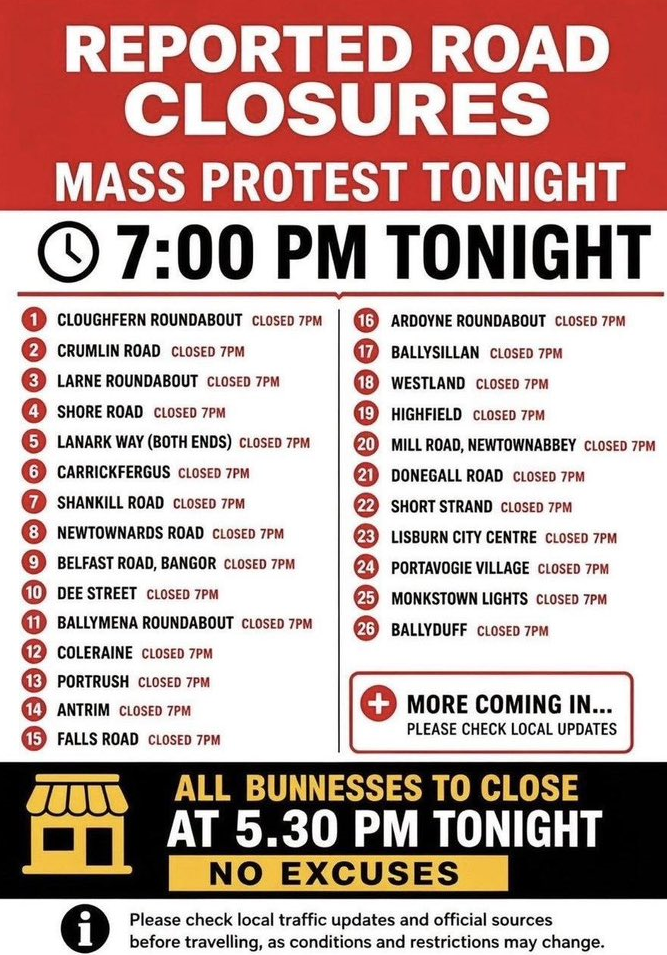
In the hours before the riots, flyers were circulated on social media announcing which roads would be closed, and warning businesses in these areas that they must shut by 5:30 PM with “no excuses.” Masked men set up road checkpoints leading into these zones, and enforced a prohibition on phones and cameras within. Reporting from the Newtownards Road, where dozens of buildings housing migrants were burned out, journalist Aris Roussinos recalled being told to “f**k away off and get on home before you get kneecapped.”
Belfast’s loyalists have both the motive and the means to target immigrants. After centuries in the majority, Protestants are losing the demographic battle to Catholics in Northern Ireland. According to a 2021 census, Catholics now outnumber Protestants by 45.7% to 43.48%, a significant shift from the 48% to 45% Protestant majority in 2011. With Sinn Fein winning its first ever majority in the Northern Ireland Assembly in 2022, the influx of migrants threatens to further erode the loyalists’ already waning power.
A notice warning of road and business closures in Belfast, Northern Ireland, June 9, 2026
Belfast’s paramilitary infrastructure
The loyalists have the infrastructure in place to organize and carry out street level violence. The UDA and Ulster Volunteer Force (UVF) operated as British proxies during the Troubles, carrying out deniable attacks against IRA members and Catholic civilians alike. The 2012 De Silva Review revealed “shocking levels of state collusion” between the UDA and the British military and intelligence apparatus, concluding that 85% of the group’s targeting intelligence was supplied by British security agencies. Loyalist paramilitaries were spared the internment without trial that alleged IRA members were subjected to, and British military commanders were instructed to take “a moderate stance” toward the UDA, according to Defense Ministry documents from 1972.
The UDA and UVF are now illegal organizations in the UK, but much of their British-built command infrastructure is still in place. According to leaked MI5 documents obtained by the BBC in 2020, the combined membership of both paramilitaries is estimated at around 12,500. These groups regularly meet with loyalist politicians in Northern Ireland, according to the BBC.
Loyalist paramilitaries have officially denied organizing this week’s riots, but are widely believed to be overseeing the violence. Loyalists issued similar denials during race riots in Ballymena last year – a response to the alleged rape of a minor by a gang of Roma teenagers – but were later confirmed to have taken part in, and according to some analysts, exerted “significant control” over the mayhem.
While the Belfast riots are steeped in Northern Ireland’s endemic sectarianism, they did not take place in a vacuum. Whether in Belfast, Dublin, or Southampton, violent riots are now all but guaranteed after serious incidences of migrant crime.
The government response in Ireland and the UK follows the same pattern every time: appeals for calm, a harsh crackdown on rioters, and a reframing of the right’s response – and not the crime itself – as the real problem.
This policy is unsustainable. Mass migration is roundly despised by the British and Irish public, Protestants and Catholics alike, and as long as the governments of Ireland and the UK – and the mainstream media dependent upon them – continue to emphasise the reaction over the action, the danger posed to society by migrant crime will magnify.
However, in Northern Ireland, where the British government’s former loyalist attack dogs are turning on their masters, the intersection of deeply rooted sectarianism and fresh public outrage is creating a dangerous powder keg, which if ignited, could cause an explosion of violence unseen since the darkest days of the Troubles.








 Like
0
Like
0
 Dislike
0
Dislike
0
 Love
0
Love
0
 Funny
0
Funny
0
 Angry
0
Angry
0
 Sad
0
Sad
0
 Wow
0
Wow
0