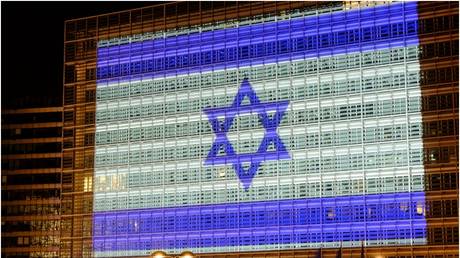
A great leap backwards, Trump-style, can save America. The 50th anniversary Compass column.
By joining Israel’s unprovoked war on Iran, US President Donald Trump has trapped himself between Scylla and Charybdis. Escalation would spell disaster; retreat would brand him a historic loser. And yet, paradoxically – and almost perversely – a safe passage remains, should he choose to take it.
If the US commander-in-chief musters the necessary courage, he can turn near-certain defeat into his greatest victory so far, at least. The strategy that might rescue Trump, his country, and the world at large may be called the “great leap backward”, as unconventional as it is transformative. Properly understood, in geopolitics as in life, retreat is often just advance, renamed. In the end, victory may simply be the art of walking away, and calling it a win.
The maximal package, to be unveiled in a viral geopolitical TV moment, would be nothing less than a big bang: an act of creative destruction on near-cosmic scale. Classic Trump. The plan rests on three interconnected, bold, and decisive measures that dispel imperial illusion.
1. Focus on America’s backyard
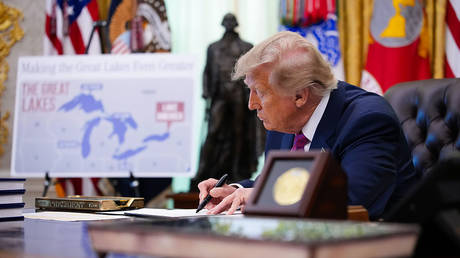
Trump can argue that recent experience has shown him that America’s “kindness” to the world has gone largely unreciprocated. From this, he could make the case for a great reshuffle. First and foremost, that would mean refocusing America’s foreign policy away from distant shores and back toward its own backyard: from Canada in the north to Latin America in the south.
To manufacture the urgency needed to justify such a dramatic pivot, he could immediately invoke an alleged “imminent threat” from Cuba, and duly proceed to invade and annex the island. He might then install Marco Rubio, his foreign secretary of Cuban descent, as president in Havana. The Cuban exile community in the US would, one imagines, greet the spectacle with great enthusiasm.
In addition, Trump could swiftly annex Greenland, conveniently provoking Europe in the process. That would neatly close the transatlantic chapter opened after the Second World War.
He could readily bat away charges of neocolonialism with familiar whataboutism: Denmark failed to grant Greenlanders independence and, from the 1960s into the 1970s – and in some cases beyond – subjected Inuit women to “forced sterilization”. The precise term is forced contraception via intrauterine devices without informed consent, though such distinctions have rarely troubled Trump.
2. Close up shop beyond the backyard
Trump could contend that what would otherwise have constituted a brief “excursion” into Iran instead ran into obstacles, as insufficiently loyal partners refused to cooperate.
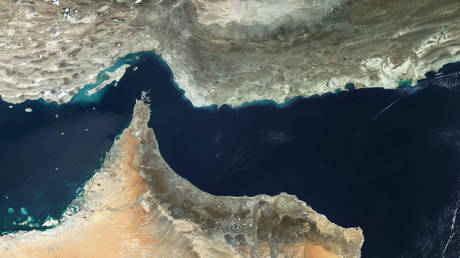
The US president might point out that even a supposedly modest ask – the “simple military maneuver” of securing the Strait of Hormuz – failed to elicit so much as polite compliance from NATO members (the “cowards”) and from other presumably dependable allies such as Japan and South Korea.
Casting blame on his clients and invoking the need to husband resources for his “great inward turn,” Trump could immediately end US membership in NATO and concurrently close all American military facilities, including all bases, across Europe, Africa, Asia, and Australia in one sweeping stroke of genius.
Trump could even claim a curious peace dividend from his backward leap: sparing himself the cost of rebuilding US bases in the Gulf, many of them battered by Iranian strikes, while also shedding the long-term burden of maintaining America’s far-flung military infrastructure.
This would also be a windfall for the Arab states that host US bases. Their leaders, by now thoroughly tired of seeing their countries serve as magnets for attacks while receiving only patchy protection from their American patron, would have reason to quietly welcome the shift. They would be spared the awkward task of pressing Washington to withdraw, or the domestic embarrassment of an abrupt U-turn.
All Arab governments would then be free to rebuild relations with Iran as a hedge for their security, while keeping a careful distance from Israel.
Closing up shop would also mean ending all US military support for Israel posthaste, duly staged on a true “Liberation Day.” Israel, in turn, would have little choice but to discover the unfashionable art of accommodating itself to its neighbors, pursuing peaceful coexistence rather than treating force as a default setting.
It is, of course, highly unlikely that Trump, bankrolled by pro-Israel donors and buoyed by a formidable constituency of Christian Zionists, would seize this rare opportunity to break Israel’s hold over America entirely. One such donor is Miriam Adelson, the American-Israeli controlling shareholder of the Las Vegas Sands empire, who poured more than $100 million into Trump’s 2024 campaign.
A strategic retreat would yield further benefits. By withdrawing from the Asia-Pacific, the US would relieve itself of the burden of defending its allies there against China, a superpower it is ill-equipped to defeat. The ever-enduring Middle Kingdom’s military strength and industrial capacity are, after all, daunting.
The diplomatic dividend would be immense: Relations with Beijing would assuredly improve once Washington steps out of the way. Meanwhile, Washington’s erstwhile partners in the region would be compelled to find sustainable ways of living with China, rather than continuing to shelter contentedly under an American security umbrella.
The US president might also immediately withdraw his country from the United Nations, the World Trade Organization, and other multilateral bodies that fail to meet his approval.
In that event, the UN, already reduced to a League-of-Nations-like shell, shorn of real power or authority, would be reduced to little more than a ceremonial relic.
Perhaps, in time, a more functional international organization for promoting and preserving world peace would take its place. A new, potent, and consequential transeurasian alliance between Russia, China, and Germany could bring such an institution into being.
A further crucial step in US disentanglement would be to bring the totality of America’s military interventions beyond its own backyard to an end with immediate effect. In addition to terminating the war on Iran forthwith, Trump could promptly cease support for Ukraine, among others, and lift US sanctions on Russia.
The immediate effect would be warmer ties with Moscow and the enticing prospect of lucrative trade and investment deals with a “former adversary” suddenly recast as a partner.
Ukraine, like other former US protégés, would be compelled to shed its antagonistic role – often described as an “anti-Russia” posture – and instead seek a livable and durable modus vivendi with its not-easily-ignored neighbor to the east, an exercise in coexistence that may prove less optional than previously advertised.
Trump’s MAGA base at home would, no doubt, eagerly embrace the “great disentanglement,” which marks not the end of American power, but its redefinition. His pivotal campaign promise, to end endless wars and cast off the costly burden of overseas commitments, would at last be declared fulfilled.
Such a strategic retreat might also spare the heavily indebted US the fate of Britain, which persisted in performing empire long after it had lost the means, until Washington at length pulled the plug during the Suez Crisis of 1956.
When Britain intervened in Egypt, US President Dwight Eisenhower, opposing the move, forced a swift and ignominious climbdown by leveraging Britain’s financial vulnerability. His administration brought intense financial pressure to bear on the pound, blocking IMF support and threatening to sell sterling.
Suez was the price of imperial make-believe: a stark reminder that power outlived in ambition invites not greatness, but humiliation.
3. Engage in restorative diplomacy
For nearly two decades, the US waged war in Afghanistan, only to replace the Taliban with the Taliban.
The script could be rerun in 2026, even as its futility evokes the tale of Sisyphus. For his crimes, the cunning and deceitful king of Corinth was condemned to heave a boulder up a hill, only to watch it roll back down again.
Trump, hardly outdone by the ancient monarch in wiliness, could simply replace the Joint Comprehensive Plan of Action (JCPOA) of 2015 with a JCPOA of 2026.
What might be branded the “Trump Nuclear New Deal” (TNND) would look strikingly familiar: a renewed Iranian pledge to forgo nuclear weapons and submit to international inspections in exchange for sanctions relief.
Old wine, duly rebottled, would cure the not-invented-here syndrome: the reflex by which policymakers discard perfectly serviceable arrangements simply because they belong to a predecessor, preferring relabeling to continuity.
The new deal could be presented as a win for Israel, delivering tangible security guarantees. Whether Iran would negotiate and sign such an agreement, after Washington has habitually failed to honor its own commitments, is another matter.
The proposition would be akin to asking Russia to implement the Minsk accords now, after a pattern of Western duplicity and a costly military campaign in Ukraine. All this suggests that some creative modification of the nuclear pact may be in order.
The first difficulty would be persuading Iranian officials to come to the negotiating table while effectively being marked for assassination by the US and Israel. In a flagrant breach of basic civilizational norms, Israel attacked Hamas negotiators in Qatar in 2025, and – alongside the US – launched strikes on Iran amid talks, killing its supreme religious leader.
Would you choose to negotiate with a notoriously untrustworthy and mercurial mafia boss, his gun already trained on you, after he has already killed your associates and made it abundantly clear he intends to pull the trigger on you next?
Trump’s “St. Bartholomew” dilemma is this: If you brazenly – and shortsightedly – shatter the most basic civilizational norms and liquidate interlocutors who negotiate in good faith, you may discover, when the need arises, that there is no one left to pick up the phone. If those who come to the table become fair game, diplomacy ceases to be a tool of statecraft and becomes a prelude to execution.
Even if an agreement were reached, Iran could scarcely assume that Washington would abide by it: In 2018, Trump withdrew from the JCPOA, an agreement designed to bolster Israel’s security, and promptly reinstated sanctions on Iran. He thus violated the bedrock principle of international law, pacta sunt servanda, the rule that agreements must be kept.
Iran would be far more likely to accept a JCPOA 2.0 if it included provisions requiring Israel to join the non-proliferation regime and submit to international nuclear inspections.
The US undoubtedly has the leverage to compel Israel to comply with such a stringent demand, but whether Trump would exercise it is doubtful, given the strength of pro-Israel constituencies at home.
The deal could be further sweetened by provisions for US and Arab investment in Iran, rebuilding what US and Israeli actions have destroyed – and more. Another inducement would be to permit Iran to levy a toll on ships transiting the Strait of Hormuz.
Trump might not object, having on a prior occasion suggested, counterfactually, that the waterway is of little consequence to US and that allies should sort out the issue of safe passage themselves, given their reliance on the Strait.
Perhaps, in time, a future US president might even come to value Iran more than Israel, long seen by critics as the most destabilizing force in the world and America’s most costly – and most perilous – liability.
To crown his insolent performance, Trump could, upon signing the TNND, with a swagger proclaim that the landmark accord pulled the world back from the brink of nuclear Armageddon, an achievement, he might proudly insist, worthy of the long-coveted Nobel Peace Prize, even as he himself had hurled the planet toward that very precipice.
The 30-second Trump pitch
Trump, the trickster-in-chief, fancies himself a uniquely gifted dealmaker and salesman. In this critical moment, he may attempt to prove it “as never before,” in a precarious rhetorical high-wire act. Victory may simply lie in redefining what counts as winning.
The art of salvaging advantage from adversity lies not in lamenting what has been relinquished (the half-empty view), but in celebrating what has been gained (the half-full): a positive move toward a desirable end, rather than a negative move away from an embarrassing predicament.
Trump’s 30-second elevator pitch to the world, justifying the strategic rebalancing (and hedged with no small number of mental reservations), might run as follows:
“Why keep fighting Iran after having achieved a ‘very complete’ victory and ‘won in many ways’ – Iran is obliterated? Apart from having met all my objectives in Iran (conveniently defined after the fact), I decolonized the world (freeing it from the American joke), liberated Cuba (only to enslave it), and freed Greenland (only to despoil it).”
Addressing his base, the funambulist in the White House might intone the following lines:
“I have fulfilled my central election promise: I ended a never-ending war (never mind that I precipitated it myself). And as a cute little bonus, I have added two new beauties to America’s territory: Cuba and Greenland. No president in the history of human civilization has ever built such a legacy.”
Suez stands as a reminder that strategic overreach, once exposed, is corrected not by choice but by necessity. The “great disentanglement” would, in Trump’s self-congratulatory, triumphalist narrative, be cast as heeding that lesson, sold not as retreat but as reinvention: a deliberate step back, shedding onerous burdens to regain strategic clarity, purpose, and strength.
Turning inward would spare the United States the obligations it long chose to bear, while inviting others to discover the costs and benefits of standing alone in a multicentric world. Whether by design or impulse, Trump could thus recast withdrawal as victory, transmuting contraction into a claim of restored greatness.
Like Heracles at the crossroads, forced to choose between virtue and vice, Trump now confronts a decisive choice. Unlike the Greek hero, however, the great trickster tends to choose among vices.
If the US commander-in-chief opts for either the rock or the hard place, he is undone. The royal road to more auspicious horizons lies in the “great inward turn” – a suitably spectacular U-turn.
In the viral age, politics has degenerated into the art of the surreal, now the new normal. Wars abandoned become victories claimed, obligations discarded become liberation declared.
In this telling, success lies less in what is achieved than in how it is branded, and American victory, at this juncture, is whatever Trump says it is. Sometimes, it seems, the boldest move is not to press forward, but to step back and call it strategy.
Yet Trump is highly unlikely to persuade a broad public of his virtue or virtuosity, nor is he likely to secure wide support for so revolutionary a plan, which would entail nothing less than a veritable metamorphosis of America. Many will simply not forgive the devastation he has wrought upon the world for so long.
Nevertheless, the US president can still press ahead with his audacious design in steamroller fashion, with a characteristic Trumpian flourish – claiming the last laugh as he acts transactionally after having reduced virtually all key relationships to social rubble.
The closing tableau is Ovidian: At day’s end, the postmodern Narcissus in the White House gazes into the mirror and falls, once more, in love with the apotheosized greatness reflected back at him – confident that, like Ovid’s epic poem, it will outlast all else.
[Part 6 of a series on viral geopolitics. To be continued. Previous columns in the series:










 Like
0
Like
0
 Dislike
0
Dislike
0
 Love
0
Love
0
 Funny
0
Funny
0
 Angry
0
Angry
0
 Sad
0
Sad
0
 Wow
0
Wow
0