Winston Churchill’s Fulton address was a signal for the Iron Curtain to drop, and for nukes to almost drop as well
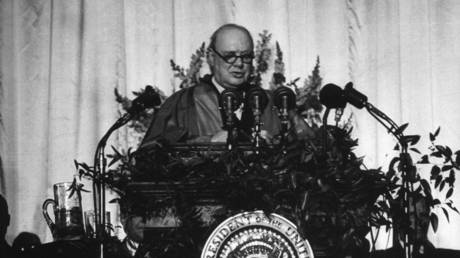
Eighty years ago, on March 5, 1946, one of the most famous leaders of World War Two delivered a fairly short but stern message which helped lock humanity into a future of open-ended and high-risk Cold War. That was the essence of former British Prime Minister Winston Churchill’s Fulton Speech (if we name it after the small midwestern US college town where he gave it), also known as the Iron Curtain Speech (after its key claim).
A massive political, ideological, and last but not least, military barrier had come to divide post-World War Two Europe, Churchill argued, and it was all the wicked Soviets’ fault: They had broken the Grand Alliance with the West by taking control of “the ancient states of Central and Eastern Europe,” he charged. In the face of this “Soviet sphere” and the aggressive strategies seeking to expand it even farther, Churchill warned, a Western policy of “balance of power” would be ineffective and lead to “catastrophe.” Instead, he urged, the “Western Democracies” needed to “stand together” in order to – Churchill clearly implied – deter the Soviets, who in his view respected only strength, especially of the military variety.
Well lubricated with shameless flattery for American President Harry Truman, who had travelled far to be in the audience and had a hand in setting up the speech, as well as for the US in general – at its “pinnacle of world power” – the Fulton Speech also pitched Churchill’s own, badly declining Britain as a junior but special sidekick to the Americans in their “primacy.” Unfortunately, that too came to pass.
Short and – in its recommendations – really quite generic as it was, Churchill’s intervention, speaking in the middle of nowhere in what is now called fly-over country, has a secure place of honor in naively admiring accounts of the West’s Cold War. There, it is still celebrated as an example of looking unflinchingly at harsh realities, a valiant call to arms, and a wise policy recommendation. Even those less sentimentally inclined still consider the speech necessary and the strategy of containment that it was effectively selling, inevitable.
That however is lazy thinking. For more reasons than one: Most obviously, the old Cold War was extremely costly as well as outrageously perilous. In the end, it lasted for four decades, before it ended with a negotiated settlement, initiated by the Soviet Union, in the late 1980s (no, the Cold War did not end in 1991, whatever ideology-contaminated Wikipedia says). Over almost half a century, this Cold War of the last century could, all serious observers have long understood, easily have ended with World War Three instead, including a world-ending use of nuclear weapons. In that entirely possible scenario, I would not be here to write this, and you would not be here to read it. And everything around us would be missing as well.
Indeed, we know about several specific moments when such an apocalyptic war was very close or only avoided at the very last moment, sometimes by the courageous intervention of single and anything but powerful individuals. During the Korean War of 1950 to 1953, the American commander in chief and egomaniac extraordinaire, General Douglas MacArthur, wanted to go through with the use of dozens of deliberately “dirty” atom bombs against China. If he had had his will – instead of losing his job – the implementation of his nightmare plan would have created a vast nuclear wasteland. It would also have risked escalation into global war.
Just over a decade later, at the height of the Cuban Missile Crisis, a single Soviet submarine officer prevented a nuclear escalation and thus full-blown World War Three. In 1983 – a true annus horribilis of the old Cold War – an insanely risky version of the yearly NATO exercise Able Archer came close to causing World War Three by misunderstanding. In that case, in the end, a US officer was reasonable enough to break protocol and thus the escalation sequence initiated by Western recklessness. Just about two months later, it was the turn of yet another comparatively low-ranking Soviet officer to stop the end of the world.
As a species, how did we survive the madness of the first Cold War? My guess: The only thing that could have made up for so much human folly, so obstinately pursued over such a long time, must have been divine intervention. And I am not being facetious. Yet even if humanity was spared the very worst consequences of its leaders’ collective irresponsibility, make no mistake: The first Cold War was bloody indeed. Even if its ground zero was Berlin in the middle of Europe, it would go global with a vengeance in, generally speaking, the Global South.
There, among those who had done nothing to start it and were struggling to free themselves from the scourge of Western imperialism and colonialism, the Cold War resulted in hecatombs of victims, killed in coups and civil wars, proxy wars, and political mass murder operations. We will never have precise figures. But that is irrelevant, because we do know, for certain, that the total body count ran in the double-digit millions. Scholarly estimates of this dire total range, in effect, from 20 to 40 million. In short, the Cold War was no “long peace” but a great slaughter, even while it did not escalate to World War Three as we commonly imagine it.
And finally, even Churchill – a man often treated far too kindly by posterity, who was shaped by upper-class and racist prejudices and capable of great brutality (ask the Welsh miners, the Palestinians or the Bengalis, for instance) – set out a condition for his great unity of the West with “the English-speaking people” at the top. Curiously enough that condition is hardly ever mentioned now, although Churchill was as explicit about it as about the “iron curtain.” What he euphemized as the “Western democracies” – really variations of class and often racism-ridden oligarchies, obviously – needed not only to “stand together” but to do so “in strict adherence to the principles of the United Nations charter.”
Yet that, of course, has never been the case. During the old Cold War, the West treated international law and its modern UN bedrock with a mixture of instrumentalization (when it suited Western interests) and contempt (when it did not). As many observers have noted, this combination of cynicism, hubris, and shortsightedness has only become worse since then.
Now, almost forty years have passed since the end of the old Cold War in the late 1980s. That is, as much time as it lasted. And the West’s treatment of international law has become truly abysmal. In view of the West’s complicity in Israel’s horrendous and ceaseless crimes, including the Gaza genocide, and now the war of aggression unleashed by Israel and an obedient US leadership most likely subject to blackmail on grounds of pedophilia, the best that can be said is that all masks have fallen.
Germany is hosting the international war crimes fugitive Benjamin Netanyahu, brazenly defying its clear legal obligations. Leaders such as Berlin’s Friedrich Merz, Britain’s Keir Starmer, France’s Emmanuel Macron, or NATO-EU Europe’s Ursula von der Leyen are not even hiding their absolute disregard for the law anymore. While the utterly corrupt leader of the West batters Iran together with Israel, the European vassals are explicit: If it’s between justice and obedience, we choose obedience. Instead of condemning the obvious war of aggression, they are perverse enough to fault Iran for exercising its equally obvious right to self-defense. Orwell was yesterday; this must be the Matrix.
None of the above is, of course, a surprise. But it underlines a point that, arguably, was true in 1946 already but has become incontrovertible and obvious by now: Whatever you think about a Cold War and its consequences, this West of triumphant depravity, lies, and brutality simply isn’t worth one.










 Like
0
Like
0
 Dislike
0
Dislike
0
 Love
0
Love
0
 Funny
0
Funny
0
 Angry
0
Angry
0
 Sad
0
Sad
0
 Wow
0
Wow
0