Thousands remain stranded in Ceuta following a massive influx from Morocco that has overwhelmed local authorities
Hundreds of Moroccan migrants have protested in Spain’s North African enclave of Ceuta, demanding asylum as thousands remain stranded in the area following mass border crossings last month.
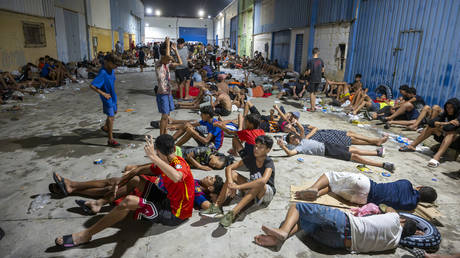
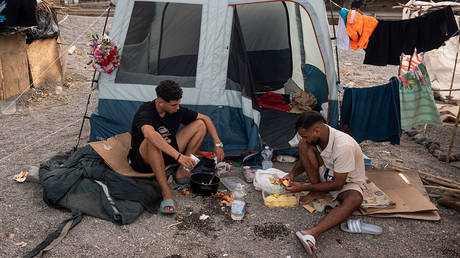
The crisis erupted on July 30-31, when an estimated 72,000 migrants entered Ceuta from neighboring Morocco – equivalent to roughly 70% of the enclave’s population of around 84,000. While most returned shortly afterward, an estimated 7,000 to 9,000 remain, straining reception centers, hospitals, and law enforcement.
The influx has triggered a bitter dispute over the migrants’ fate. Ceuta Mayor-President Juan Jesus Vivas has called for asylum claims linked to the surge to be rejected and migrants returned to Morocco.
Spanish Interior Minister Fernando Grande-Marlaska backed the hardline approach last week, saying irregular arrivals would not be allowed to remain in Ceuta, reach mainland Spain, or obtain legal status, except in rare cases of extreme vulnerability. Judicial associations have pushed back, insisting claims must be assessed individually and that illegal entry does not forfeit the right to seek asylum.
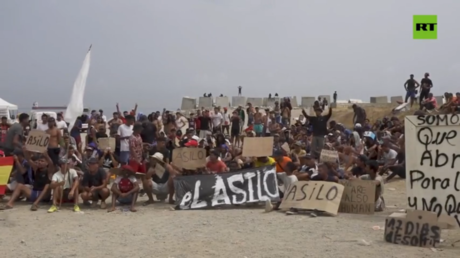
Amid the row, several hundred migrants staged a sit-in on a popular Ceuta beach on Sunday, urging the Spanish authorities not to return them to Morocco. Footage shows protesters waving Spanish flags and banners while chanting: “We need asylum!”
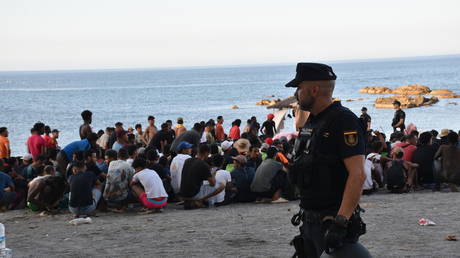
“We Moroccans are protesting without food or water, we will continue sitting here,” one protester told the Ruptly video agency. Separate footage shows security forces detaining several migrants on the beach, though it is unclear if they were part of the protest.
The initial surge came shortly after Spain’s Supreme Court ruled that migrants intercepted at sea while trying to reach Ceuta or Melilla, another Spanish enclave, could not be immediately deported. Spanish officials have accused trafficking networks of exploiting the ruling through viral social media posts falsely claiming the country’s borders were open.
Another wave of nearly 300 migrants attempted to enter Ceuta on Saturday but was stopped by Moroccan police, according to state broadcaster Medi 1 TV. Another 61 Moroccans accused of facilitating the attempt were arrested, the broadcaster said.
Brussels sticks to sidelines as migrant row deepens
Multiple EU members have pinned the blame for the Ceuta crisis squarely on Madrid and its permissive approach toward migration. Leaders of 22 EU nations accused Spain of undermining the bloc’s security in an August letter, with several calling for its exclusion from the Schengen borderless travel zone. Italy introduced temporary checks on travelers arriving from Spain on August 1, while France tightened border security.
Madrid hit back, branding the measures and criticism “selfish,”“polarizing,” and “unlawful.” It retaliated against Italy’s move by imposing reciprocal restrictions on travelers arriving from the country starting August 8.
Brussels, meanwhile, has largely sought to sit out the increasingly bitter dispute. The European Commission has refrained from penalizing Spain over the Ceuta crisis and praised Madrid for preventing irregular migrants from reaching mainland Europe, while dismissing calls for Schengen restrictions. However, it has also stopped short of offering Madrid substantial backing, so far limiting its response to sending a team of migration experts to Ceuta to assess what additional financial and operational support may be needed to secure the EU’s external border.
Migration has become an increasingly explosive issue in the EU, fueled partly by high-profile sexual abuse and assault cases involving migrants. Critics say Brussels’ asylum protections, burden-sharing schemes, and expanded legal migration pathways have created incentives for illegal migrants.
Commenting on the crisis, Russian presidential envoy Kirill Dmitriev also blamed EU migration policies, suggesting that “migrants are coming en masse to personally thank Ursula [von der Leyen] and other migration-friendly EU bureaucrats for their great migration incentives.” In a separate post, he warned that the “failure to admit migration mistakes is undermining what is left of Europe.”
Legacy media tries to hide this and calls the stories about Ceuta “Russian propaganda.” Failure to admit migration mistakes is undermining what is left of Europe. https://t.co/4rjJlfNa1S— Kirill Dmitriev (@kadmitriev) August 17, 2026














 Like
0
Like
0
 Dislike
0
Dislike
0
 Love
0
Love
0
 Funny
0
Funny
0
 Angry
0
Angry
0
 Sad
0
Sad
0
 Wow
0
Wow
0