The right-wing party came in first with 43.8% of the vote in Saxony-Anhalt, with Chancellor Friedrich Merz’s CDU trailing far behind at 17.5%
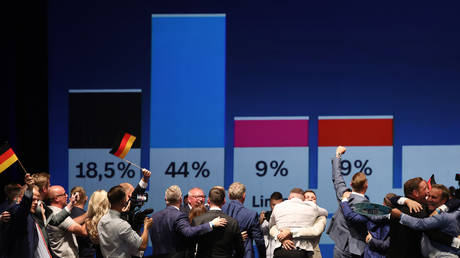
The opposition right-wing Alternative for Germany (AfD) party has won Sunday’s regional election in Germany’s eastern state of Saxony-Anhalt with 43.8% of the vote, according to official preliminary results. The AfD is set to claim 39 out of 97 seats in the local legislature, falling short of a governing majority.
The vote was marked by a record turnout of 78%, the highest since the reunification of Germany in 1990.
Chancellor Friedrich Merz’s Christian Democratic Union (CDU) party finished in a poor second, securing just over 17.2% of the vote and 15 seats, the results indicated.
AfD lead candidate in the state, Ulrich Siegmund, said the party has “written history” and that the outcome of the vote would “shake all of Germany.”
“We are going to get our country back, and we are starting with Saxony-Anhalt,” he said.
The Germans have given the AfD their trust and it “will not disappoint them. We will not become like these other parties,” Siegmund added.
AfD co-chair Alice Weidel earlier did not rule out forming a coalition government in the region, including with Merz’s Christian Democrats, should the right-wing party fail to secure an absolute majority.
After the exit polls gave victory to the AfD, Sven Schulze, the CDU lead candidate in Saxony-Anhalt and the outgoing regional head, conceded defeat, congratulating the opponents on their electoral success.
“That’s democracy,” Schulze said, adding that voters have sent a clear message which must be heeded, both at the regional and federal levels, as quoted by German media.
Schulze attributed his party’s poor showing to the unpopular policies pursued by the federal coalition government, which is comprised of the CDU and the Social Democratic Party (SPD).
SPD co-leader and Vice Chancellor Lars Klingbeil similarly spoke of a “signal to Berlin,” insisting, however, on the continuation of the so-called ‘firewall’ policy, under which all major parties refuse to cooperate with the AfD.
AfD co-chair Tino Chrupalla said that the outcome of the Saxony-Anhalt regional elections have demonstrated that voters reject the controversial ‘firewall’ policy by ‘voting out’ the mainstream parties.
According to preliminary results, the SPD has finished third with 9.3% of the vote, followed by the Greens and the Left Party with 8.9% and 8.6%, respectively. The Sahra Wagenknecht Alliance (BSW) has also narrowly secured the spot in the legislature with 5.3%.
Over the past several months, opinion polls have consistently shown that the AfD is the most popular party nationwide, enjoying the support of 28% of respondents.
Having the largest opposition faction in the Bundestag, the party campaigns on an anti-immigration platform and is also highly critical of the German government’s support for Ukraine, as well as sanctions against Russia.
An INSA poll published by Bild in late August indicated that support for Germany’s governing Christian Democratic CDU/CSU bloc had fallen to 20%, with some 78% of respondents dissatisfied with Merz’s coalition government.















 Like
0
Like
0
 Dislike
0
Dislike
0
 Love
0
Love
0
 Funny
0
Funny
0
 Angry
0
Angry
0
 Sad
0
Sad
0
 Wow
0
Wow
0