The Iran-aligned group has captured the Red Sea port city of Mocha overlooking the vital shipping route linking Europe and Asia
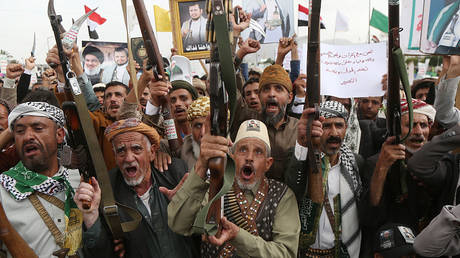
Yemen’s Houthis have seized the crucial Red Sea city of al-Makha (Mocha), tightening their grip on the strategic Bab al-Mandeb Strait, the organisation’s spokesperson told RT on Thursday.
The Houthis pushed Saudi-backed government forces out of Mocha after several days of fierce fighting, reportedly capturing both the city and its port. Videos circulated by OSINT accounts online appear to show Houthi forces entering the strategic port city as the group continues its advance toward full control of Yemen’s Red Sea coast.
The organisation’s spokesperson, Mohammed Al-Bukhaiti, told RT that while it is fighting directly against Saudi forces, it is prepared for a potential expansion of the conflict if any other country “becomes embroiled in the aggression against Yemen.”
“Of course, we now control Bab al-Mandeb, but the goal of our battle remains liberating Yemen and restoring its sovereignty and independence by ending the Saudi aggression and ending the blockade that has caused great suffering to Yemen,” Al-Bukhaiti said.
The Houthis are committed to protecting the freedom of maritime navigation in the Bab al-Mandeb Strait and the Red Sea, and “do not target any country except the Saudi enemy,” the spokesman added.
Houthi forces captured the key coastal city of Mokha overnight after Saudi/UAE backed forces retreated.
“This is one of the most important objectives of our military operations, because the one infringing upon maritime navigation is Saudi Arabia and its allies, as they prevent commercial vessels from travelling to and from Yemen,” he said.
The Houthis have also reportedly landed forces on the strategic Hanish islands after pushing government troops further south. An unnamed military source told Reuters the group seized Zuqar Island after rocket attacks and an amphibious assault. Control of the area would further strengthen the Houthis’ position, potentially cutting government supply routes and depriving Saudi-backed forces of a key logistics hub, sources said.
Yemen’s internationally recognized government has not confirmed Mocha’s capture. However, Lt. Gen. Tareq Saleh, whose forces controlled the city, said earlier Thursday he had ordered them to “reorganize their ranks and establish an alternative command center in a secure location.”
The reported advance marks a sharp escalation after roughly four years of relative calm following a UN-brokered truce in 2022. The Houthis had previously fought Yemen’s internationally recognized government since seizing Sanaa in 2014, prompting a Saudi-led coalition to intervene.
Tensions flared again in July after, according to Yemen’s internationally recognized government, its forces struck Sanaa airport to prevent an Iranian aircraft carrying a Houthi delegation from landing. The Houthis blamed Saudi Arabia, declared the de-escalation phase over and subsequently announced a naval blockade of the kingdom. By mid-August, the group was launching coordinated missile and drone strikes on camps belonging to Yemen’s Saudi-backed government, which in turn launched counteroffensives across several provinces.
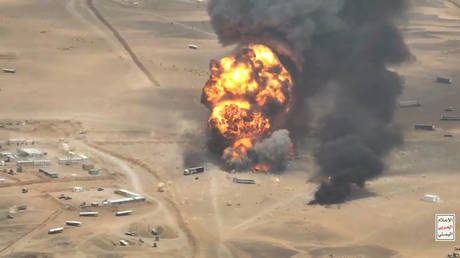
The fighting sharply escalated earlier this week. On Tuesday, the Houthis targeted energy and other infrastructure in Saudi Arabia’s south, including facilities belonging to Saudi Aramco, the country’s largest oil producer. The Houthis called the operation retaliation for Saudi strikes in Yemen, claiming Riyadh had carried out 121 airstrikes over the previous three days. Saudi aircraft carried out another 40 strikes across four Yemeni provinces on Thursday, according to the Houthi-run Saba news agency.
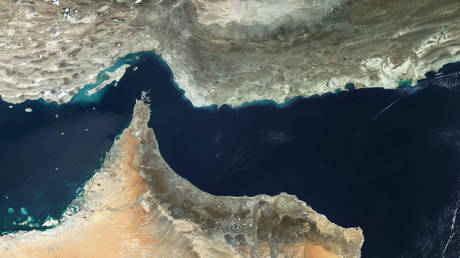
The battle for Yemen’s Red Sea coast has implications far beyond the country. Bab al-Mandeb links the Red Sea to the Gulf of Aden and Indian Ocean and carries roughly 10% of global seaborne trade. Its importance to energy markets has surged since the US-Israeli war on Iran erupted on February 28 and the Strait of Hormuz came under a de facto blockade, forcing Saudi Arabia, one of the world’s largest oil exporters, to rely more heavily on Red Sea exports.
Saudi Aramco has increasingly diverted crude through its cross-country pipeline to the Red Sea port of Yanbu. Loadings have averaged more than 4 million barrels per day since June, more than four times last year’s level. Saudi crude shipments through Bab al-Mandeb between March and mid-July were eight times higher than in the same period of 2025, making disruption to the strait a growing threat to the kingdom’s oil exports.
The Houthis have disrupted the waterway before, repeatedly attacking Red Sea shipping in 2023 in what they said was support for Palestinians during Israel’s war in Gaza.
Despite the renewed hostilities, Riyadh says diplomacy remains possible. Saudi Foreign Minister Prince Faisal bin Farhan Al Saud earlier this week accused the Houthis of prioritizing “their narrow interests” over the interests of Yemen, but insisted that “the road to diplomacy is not closed.”














 Like
0
Like
0
 Dislike
0
Dislike
0
 Love
0
Love
0
 Funny
0
Funny
0
 Angry
0
Angry
0
 Sad
0
Sad
0
 Wow
0
Wow
0